Your board can name the problems that keep returning to its agenda. Late payments, thin staffing, and a public that sees the service but misses the organization behind it. A new national initiative is asking nonprofits to turn that local experience into a longer-term agenda.
The National Council of Nonprofits is moving Transformation 2035 into its launch this month. Its November 16 newsletter said the launch was coming that week. The Chronicle reported the announcement on November 18. For an executive director, the useful question is what to bring to the conversation and what to expect back.
Local Conversations Will Shape the Agenda
NCN describes Transformation 2035 as a nonpartisan effort led with its network. Local Action Summits are intended to bring nonprofit staff, leaders, volunteers, and community partners together. Their ideas are supposed to inform priorities at the local, state, and national levels.
The initiative is already beyond the announcement stage. In its November 16 launch update, NCN said early gatherings in Tennessee, North Carolina, and Oregon had brought together more than 450 people. That is the organizer's participation count, not evidence that the process has already changed funding or policy.
The public plan moves from gathering ideas to building support, developing proposals, and working toward implementation. It does not give your organization a new funding commitment. Treat participation as a chance to help define shared problems, rather than a substitute for your own operating plan.
What Should Your Nonprofit Bring?
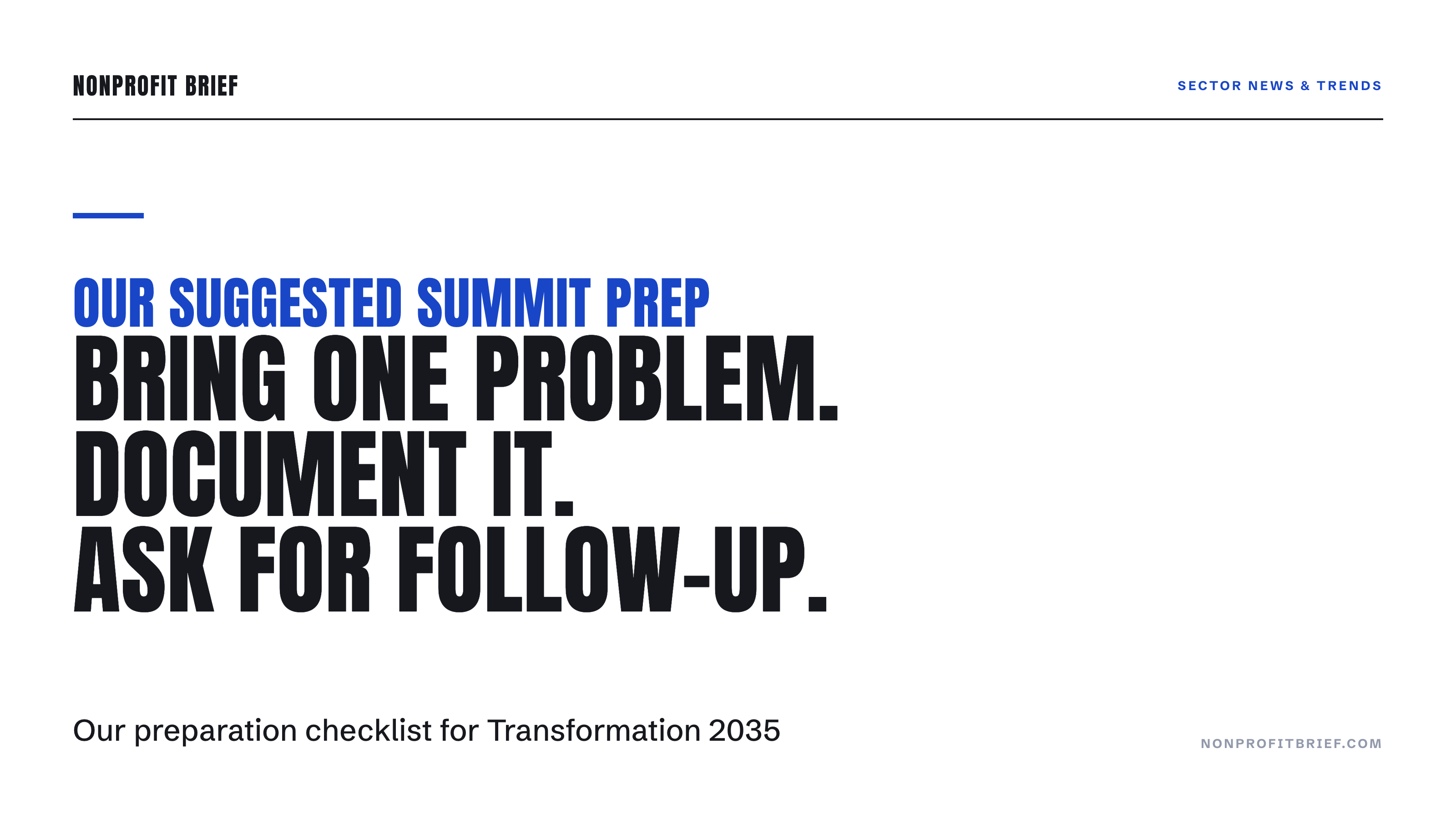
Bring a short account of a problem that reaches beyond your organization. The strongest contribution is something other groups can recognize and a decision-maker can act on. A complaint may be justified. A well-defined bottleneck is easier to build a proposal around.
For example, suppose your reimbursement payments repeatedly arrive after payroll. Prepare a simple timeline using your own records: when work was performed, when a complete invoice was submitted, and when payment arrived. Keep confidential contract details out of a public handout. Then identify the change you want explored, such as clearer processing expectations or a way to track delays.
That is an editorial recommendation for preparation, not a requirement NCN has imposed. The same approach can work for other issues: the difficulty of recruiting board members, duplicative applications, or the gap between what a service costs and what a contract pays.
Separate three things on the page: what you observed, what you think caused it, and what would help. If you have not measured the cause, say so. Giving a meeting an honest question is more useful than giving it a confident explanation your records cannot support.
Participation Starts With Your State Connection
Start with NCN's public initiative page. It describes plans for state gatherings and provides a form for sharing summit plans. Some organizer resources require member sign-in. Confirm the current route with your state association before assuming a specific event is open, free, or available to every organization.
State partners are connecting the national effort to local discussions. The Pennsylvania Association of Nonprofit Organizations described that connection in its November convening announcement. That event is past. Its value now is showing how a state association can connect its own participants to the wider initiative.
If you cannot spare a day away from operations, ask whether there is a written-input route or a later conversation. Ask who is missing from the room, too. An agenda shaped only by organizations with spare staff capacity may overlook the constraints you want it to address.
Ask How the Input Becomes Action
Before committing more staff time, ask the host how participants will see the results. Will there be a summary? Who will turn ideas into proposals? How will organizations check that a regional recommendation reflects what people actually said?
Set an internal follow-up as well. Assign someone to bring the discussion back to your board, with a short list of relevant proposals and any next decision. For context on why public understanding matters, revisit our coverage of the nonprofit recognition gap. This new initiative offers a participation route; it does not by itself establish that the awareness gap has closed.
The takeaway
Check the current state-level participation route and bring one documented problem your organization wants addressed. Ask how the organizers will report back and turn contributions into proposals. Give the effort a clear purpose inside your own organization before giving it more staff time.
Sources
- NCN initiative description, accessed November 18, 2026.
- NCN November launch update, November 16, 2026.
- Pennsylvania association convening announcement, November 5, 2026.
- Chronicle launch reporting, November 18, 2026.