A donor asks if a December 2026 gift qualifies. For calendar-year taxpayers, the new federal scholarship credit starts in 2027 and requires a recipient on a participating state’s list under section 25F of the tax code.
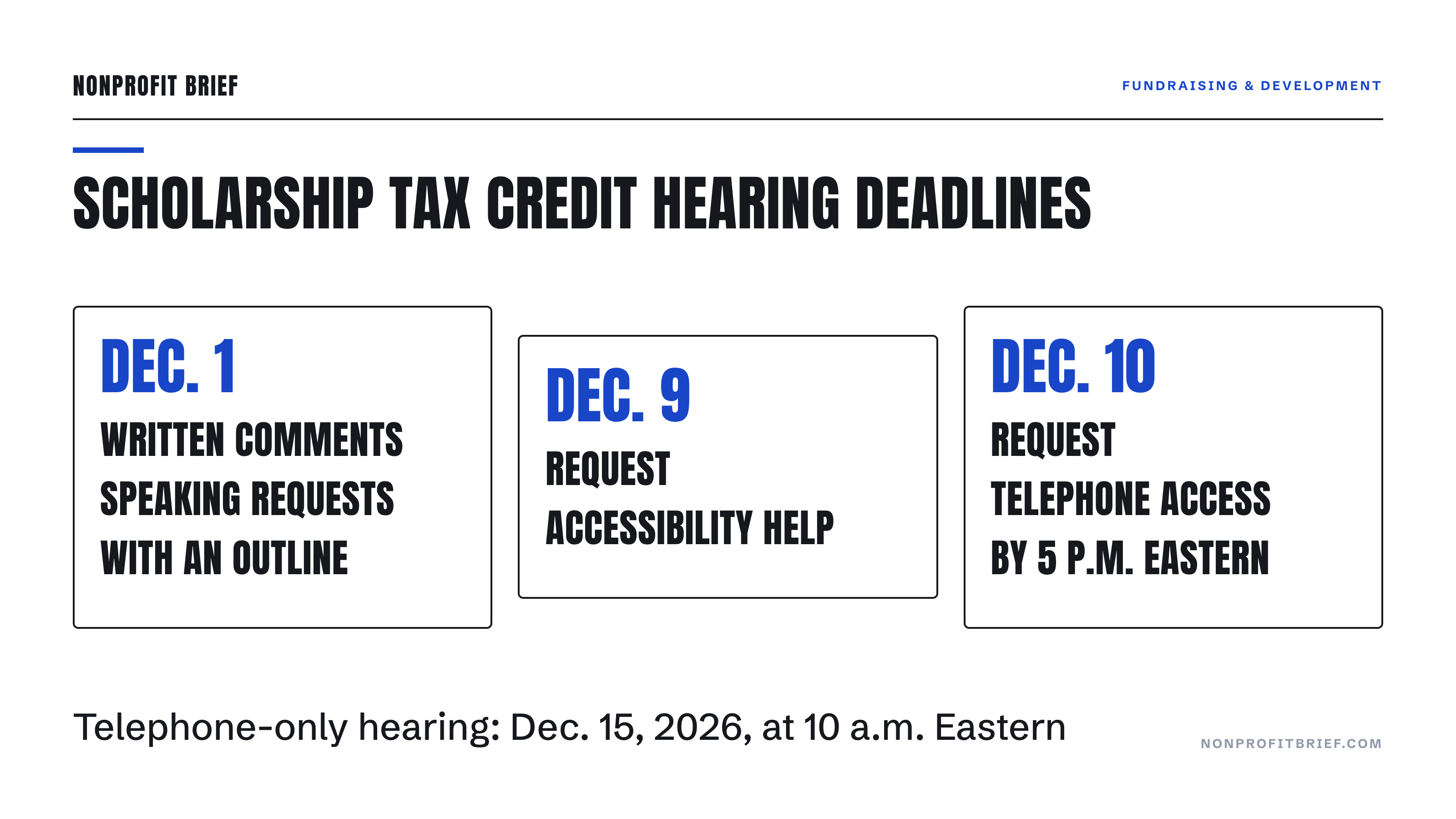
Comments on the proposed rules are due December 1, 2026. On November 12, Treasury and the IRS moved the December 15 public hearing to a telephone-only format. It remains at 10 a.m. Eastern.
What the Credit Does for Donors
Section 25F sets the cap at $1,700 per taxpayer per tax year. A U.S. citizen or resident who makes a qualifying cash contribution can claim a dollar-for-dollar credit up to the applicable limits. The credit is nonrefundable and subject to the donor’s federal income tax liability limit. An otherwise allowable credit the donor cannot use because of the tax-liability limit can carry forward for up to five tax years, using the oldest credit first.
The same-gift state credit rule reduces the federal benefit by the state credit allowed for the same qualifying contribution. The October proposal would subtract the state credit from qualifying contributions before applying the $1,700 federal cap. It would also treat spouses filing jointly as separate taxpayers for that cap, allowing up to $3,400 combined if both qualify. Both details belong to the proposal.
Under the temporary definition of qualified contributions, donors tell the SGO at payment which amount they designate for section 25F. The irrevocable designation can cover all or part of a payment in U.S. dollars, including by check or transfer. The value of any goods or services received in return reduces the qualifying amount. The IRS program instructions say to list the SGO and donor number on Form 8525. Keep the acknowledgment.
The statute also bars a federal charitable deduction for the contribution amount covered by the credit. Use your year-end appeal calendar to explain what 2026 gifts pay for. In your 2027 donor FAQ, point to eligible organizations and tell donors to check the list before giving.
Scholarship Groups Have Two Sets of Rules to Read
A scholarship granting organization, or SGO, must be a tax-exempt public charity under section 501(c)(3). It must keep all qualified contributions and their earnings apart from other funds in one or more separate accounts and maintain complete books and records for them. It must appear on the state’s list for the year. The temporary state location rule requires authorization to do business in the listing state and compliance with its generally applicable charity laws. Qualifying cash gifts fund eligible students' scholarships solely in the listing state.
The statutory scholarship requirements include spending at least 90% of organizational income on scholarships for eligible students, awarding scholarships to at least 10 students across at least two schools, and limiting awards to qualified K–12 expenses. Students must be eligible to enroll in public elementary or secondary school. The household income limit is 300% of area median gross income adjusted for family size, using household income for the calendar year before the scholarship application. Groups must verify applicants’ annual household income and family size, limit awards to eligible students, give priority to returning recipients from the previous school year and then to eligible students whose sibling received a scholarship from that organization, avoid earmarking for particular students, and refrain from awarding scholarships to people disqualified under rules similar to those for private foundations.
Treasury's temporary registration and reporting rules have a December 1 effective date and specify September 1, 2026, applicability. Groups that plan to solicit qualifying gifts must register through the IRS portal as soon as possible, preferably before they appear on a state list. Written acknowledgments are due by January 31 after the gift year. Electronic delivery requires donor consent. The acknowledgment includes the organization's employer identification number, the designated gift total, a unique donor number, and a statement of whether any goods or services were provided. If so, it includes a description and a good-faith estimate of their value. The annual IRS contribution report is due by February 28 after the gift year, generally through the portal. For each donor number, report the donor’s name, address, and total qualifying gifts.
The proposed operating rules would generally measure the 90% test using gross receipts before expenses and scholarships actually paid by the end of the following tax year. Under a proposed 85% scholarship-activity threshold, eligible single-state groups could test their segregated account. Multistate groups would have to meet that threshold and test each state account separately. Treasury also proposes an annual independent financial and programmatic audit, with results sent to each listing state, and annual compliance reporting to the IRS and listing states. Ask counsel how the proposed rules apply before restructuring your program or changing how you track its spending.
Check the State List and the Hearing Calendar
An advance election by a state signals its intent to participate. The state still has to submit its list of eligible organizations. Under the temporary rules for 2027, the state files its advance election by January 1, 2027, and can submit its list by February 15. A state that fails to complete its election on time has no qualifying organizations for that year. Ask the state’s certifying office what your group must submit.
Use the Federal Register comment link for REG-117199-25 by December 1. Requests to speak and outlines with the time allotted per topic are due the same day. The October notice says the hearing will be canceled if no outlines arrive. The updated hearing notice gives listeners until 5 p.m. Eastern on December 10 to request telephone access. Email publichearings@irs.gov and include REG-117199-25 and “ATTEND Hearing Telephonically” in the subject. Requests for accessibility assistance are due December 9. If you already requested to attend, the IRS says it will send access details without a second request.
The takeaway
Scholarship groups can contact their certifying office and flag implementation questions in December. Tell donors to check the list and designate the gift at payment. Their tax situation determines how much credit they can use.
Sources
Primary sources
- 26 U.S.C. § 25F (Office of the Law Revision Counsel).
- Temporary Treasury regulations, T.D. 10057, October 2, 2026.
- Proposed Treasury regulations, REG-117199-25, October 2, 2026.
- Updated public hearing notice, November 12, 2026.
- IRS advance election list for 2027.
- IRS rules release, October 1, 2026.
- IRS scholarship credit instructions for donors and organizations.
- 26 U.S.C. § 530, qualified education expenses.
- Federal Register comment page for REG-117199-25.