Your next relevant funder may be a specialist fund backed by a larger donor. Pivotal, founded by Melinda French Gates, uses philanthropy, investments, and advocacy to support women and young people. Its Global Leaders program offers a concrete example of that funding chain: selected people receive funds to direct to charitable organizations in their fields.
The Associated Press reported November 18 on how three selected leaders have used the money. AP says nearly all the money has already been donated, with the leaders expected to distribute their allocations by the end of 2026. That makes this a model to study, rather than a new funding round. For a nonprofit building its prospect list, the practical task is to identify who makes the grant decisions and how that fund actually works.
The Commitment Goes Through Selected Leaders
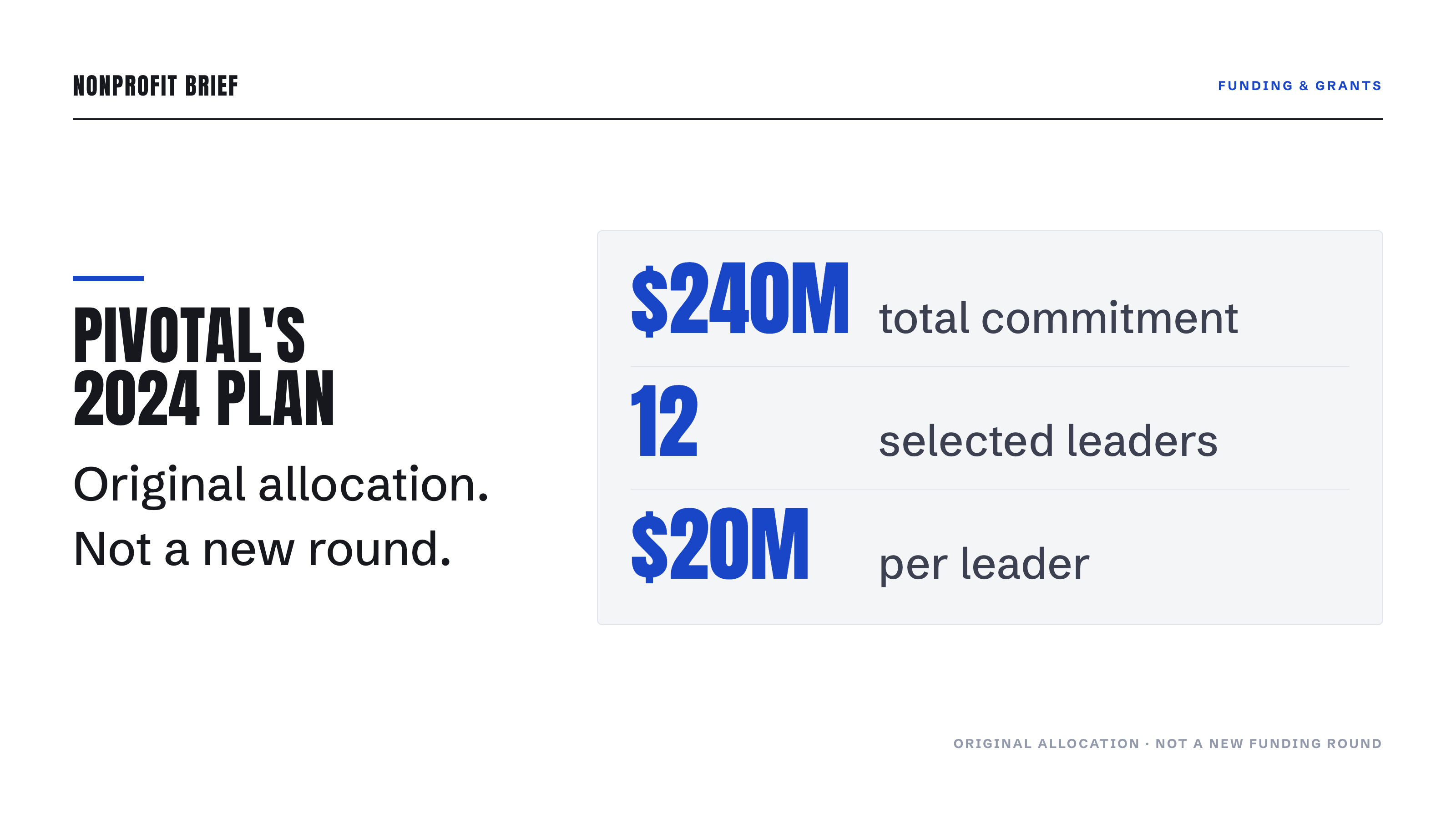
Pivotal's original Global Leaders announcement set aside $240 million for 12 people, with a $20 million fund for each. Their role was to direct grants to charitable organizations working on women's health and well-being globally. The announcement dates to 2024; this is not a new funding commitment announced today.
Pivotal's current giving overview also lists the program among its giving milestones.
For prospect research, distinguish the original donor from the person or fund making the next grant decision. A broad institutional mission is only the start. You still need to understand the work a particular decision-maker is supporting, its geographic focus, and the route, if any, through which your organization can be considered.
One Fund Shows What That Looks Like
Equimundo works with men and boys to advance gender equality. Its Caring Masculinity Fund page provides a more specific view. It says the fund, established by Equimundo President Gary Barker in 2024, is directing $15 million to organizations advancing gender equality and caring forms of manhood. The page describes support for research, programs, policy advocacy, and narrative work. It reports support for more than 80 organizations in 20-plus countries.
Those are the fund's own descriptions and counts, accessed November 18. The $15 million described there is not the same figure as the $20 million allocated to each Global Leader. Keep the two figures attached to their respective sources and scopes instead of treating them as interchangeable grant totals.
Equimundo's 2025 impact report supplies a dated account of the work. It reports that the fund distributed more than $12 million in 2025 to more than 70 organizations across 24 countries and territories. Those historical figures should not be added to the current page's counts. They cover a particular reporting period, and the pages do not provide a basis for calculating an unduplicated total.
Build the Prospect Record Around the Decision
A useful prospect record should answer four questions: what work is funded, where it happens, who decides, and what contact or application route is published. Add a date for when you last checked each answer. If the route is unclear, record it as unclear rather than turning a recipient list into an assumed invitation.
Start with the fund's own description, then examine a few named recipients. Look for an actual connection to your work: the population served, the problem addressed, or the kind of project supported. A shared cause label is weaker than a clear explanation of how your program fits the fund's stated purpose.
Our guide to finding grants systematically explains how to qualify a prospect before writing. Apply the same discipline here. Do not spend a week on a proposal before establishing whether the fund accepts one.
Delegated Decisions Do Not Prove Open Access
Pivotal's current grant-request policy says proposals are accepted by invitation and unsolicited submissions are not reviewed. It lists no current funding opportunities as of November 18. That is Pivotal's policy; it does not establish every separate leader fund's access rules.
Moving grant decisions to people with field experience changes who makes the choices. It does not, by itself, tell you how an organization enters consideration. The existence of this program is not evidence that every participating fund accepts unsolicited proposals or has money available for a new applicant now.
That distinction also matters when discussing the model with your board. A program description and a funder's own recipient counts can show how it is organized and where it says money has gone. They do not establish that the approach reaches every underfunded organization, produces better outcomes than another model, or guarantees access for your nonprofit.
Use it as a research lead with a clear stopping rule. If you cannot establish mission fit and a legitimate next step, keep the prospect on a watch list. Spend current fundraising time on opportunities your team can qualify.
The takeaway
Trace a funding commitment through to the people making grant decisions. Check the individual fund's purpose, recipients, and published access route before drafting an approach. The useful lesson from Pivotal's program is to research the decision-maker, not just the biggest name in the funding chain.
Sources
- Pivotal original commitment announcement, May 28, 2024, updated December 11, 2024.
- Pivotal current giving overview, accessed November 18, 2026.
- Caring Masculinity Fund description, accessed November 18, 2026.
- Equimundo 2025 impact report, fund-reported historical results.
- Associated Press program follow-up, November 18, 2026.
- Pivotal grant-request policy, checked November 18, 2026.
- About Pivotal, founder and organizational role.
- About Equimundo, mission and approach.