The board meeting ends with another request to help fundraise. Everyone agrees. A month later, the executive director has no introductions, no donor calls, and no idea which promise to follow up. Before treating that as a motivation problem, turn the general request into a specific assignment.
If your board members won't fundraise, start by asking what they think fundraising means. One may picture a cold call for a large gift. Another may be willing to thank a donor but unsure what to say. A third may have promised more than work and family commitments allow. Those problems need different conversations.
What should board members actually do?
Candid's board fundraising guidance describes securing resources as a board responsibility, with participation extending to gifts, in-kind support, services, and networks. BoardSource's fundraising overview likewise describes roles beyond personally asking for money. It distinguishes boards that depend on contributions from organizations with other revenue models.
As of November 2026, that guidance supports a practical starting point: agree on how this particular board will help this particular funding plan. Do not confuse an organization's giving policy with a universal legal requirement to raise a fixed sum. This is an operating approach, not legal advice about your board's duties or governing documents.
Keep fundraising connected to the broader responsibilities of board service. A board cannot replace financial oversight with a successful event. It also should not approve a contribution-dependent budget and leave the work of securing those contributions undefined.
Agree on the work before asking for names
Start with the campaign's purpose, audience, and need. Explain what staff can support. If the organization cannot arrange visits or promptly follow up introductions, do not ask every director to fill the calendar. Choose work that the team can carry through.
BoardSource's policy guidance recommends setting participation expectations and giving members training and practical tools. Put those expectations in writing, discuss them before recruitment, and revisit them together. Do not announce a new requirement halfway through a term as though everyone had already accepted it.
Try this opening from the chair: “We approved a plan that needs contributed income. We need to agree on the board's part in bringing it in. Let's choose useful assignments we can complete, with the support each person needs.” Then name the available work and the person who will coordinate it.
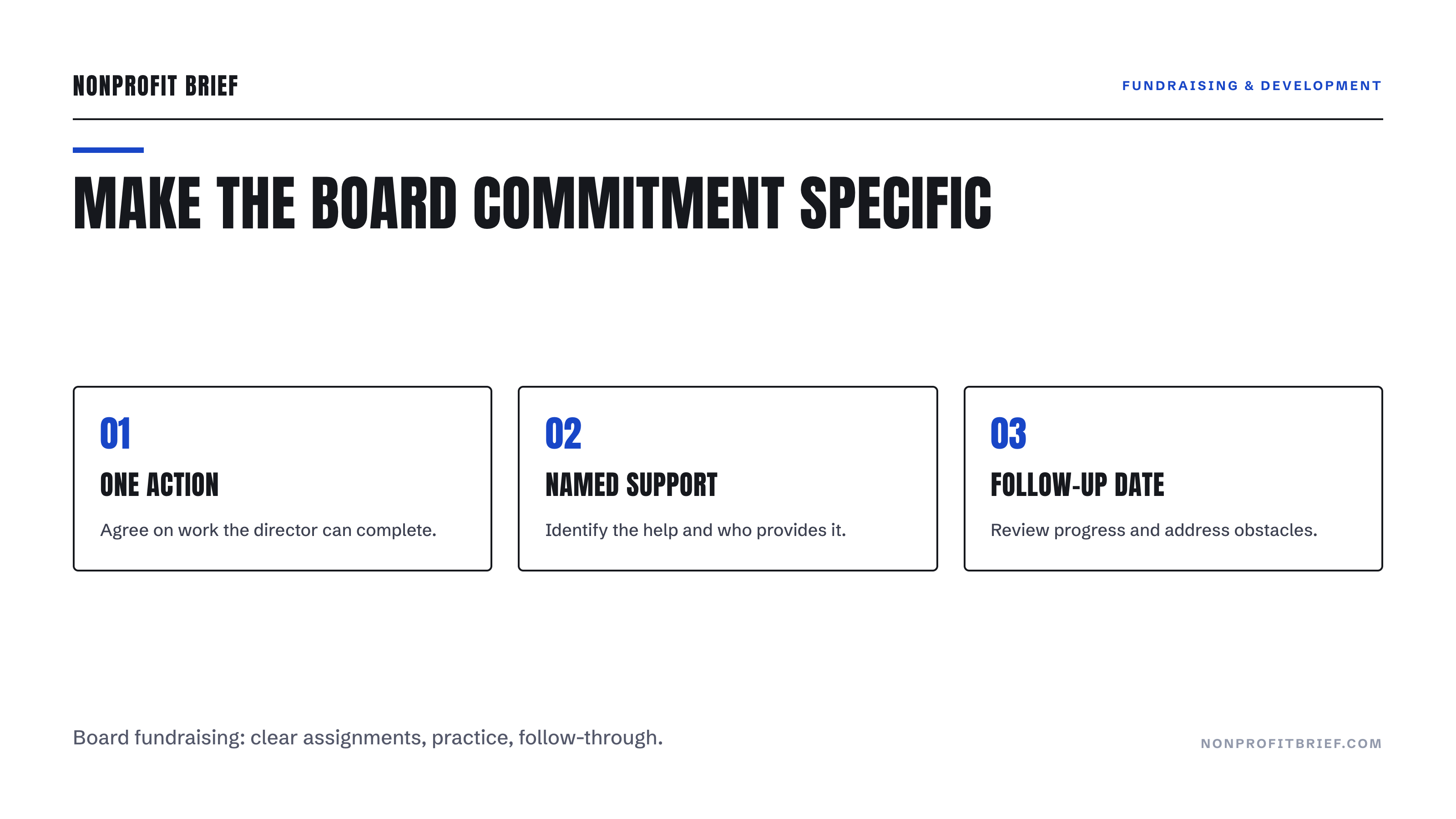
Make the commitment small enough to understand and substantial enough to matter. “Help with year-end” is not an assignment. “Make two donor thank-you calls using the approved notes before our next meeting” gives the member a task, a limit, and a point for follow-up. The numbers here are examples, not a required standard.
Offer roles across the donor relationship
Use a short menu rather than assuming everyone must do the same thing. These are suggested assignments to adapt to your staff capacity and existing policies:
- Introduce. Ask a contact whether they would welcome a conversation with the organization, then arrange it with permission.
- Invite. Bring an interested person to a briefing or visit with a clear purpose and an easy way to decline.
- Ask. Join a prepared gift conversation, with staff agreeing in advance who says what and who follows up.
- Thank. Make an authorized appreciation call that does not turn into an unexpected second solicitation.
Giving members options does not mean accepting indefinite nonparticipation. Ask each director to choose work, say when it will happen, and identify the help required. The chair or development committee should own the board's follow-through; the executive director should not have to negotiate the board's expectations alone.
For an introduction, offer an original sample message: “I serve on the board of a neighborhood program you may be interested in. Would you like an introduction to our director? There is no obligation to give.” The director can personalize it without sending someone else's contact information before they agree.
For an invitation, try: “We are holding a short conversation about the program's plans. I can send you the details if you would like to hear more.” State separately if the event includes a fundraising request. Do not describe a solicitation as a purely social visit.
Practice the conversation before it counts
Set aside part of a board meeting to rehearse. Let one director play a curious donor and another explain the program. Staff can correct an inaccurate description immediately. The point is to leave with language members understand, rather than a polished script they cannot explain.
For a thank-you call, a starting point is: “I'm a volunteer board member calling to thank you for supporting our work. I am not calling to ask for another gift. Would you like to tell us what interested you in the program?” Use it only when it is true and the call is consistent with the donor's contact preferences.
For an ask, agree on the amount and purpose with staff first. A possible opening is: “Would you consider a gift toward this program? I can explain the plan, and our director can answer questions.” Leave space for a no. Never promise a restriction, naming benefit, tax result, or program outcome you are not authorized to offer.
After rehearsal, ask what was difficult. A member who cannot explain the program needs orientation. A member who fears an awkward response needs practice handling it. A member who cannot fit the assignment into their schedule needs a different commitment or a candid discussion about capacity.
Work through two different board situations
Consider a volunteer-led neighborhood group with no development staff. One director knows several local business owners; another has time for calls but few prospective donors. For a first cycle, the chair might coordinate a small number of permission-based introductions while the second director handles approved thank-yous. Name someone to maintain the list and answer questions before outreach starts.
If the group cannot service a new relationship this month, shrink the assignment. Invite a contact to learn about a specific upcoming program, rather than promising a site visit nobody can host. At the next meeting, review whether the introduction happened, whether the person wanted follow-up, and who now owns it. This example illustrates workload design; it is not a tested fundraising forecast.
Now consider a staffed organization with a stalled board campaign. The development director has a donor plan but directors keep postponing asks. Arrange private conversations about the obstacle. Some may want staff beside them. Others may prefer to host a briefing or make stewardship calls. Allocate those roles without pretending that every interaction produces a gift.
In that second example, keep the existing donor relationship with its assigned staff owner. A well-connected director should not independently approach every person they recognize on a confidential list. Coordinate the contact, record the outcome, and avoid competing requests from different people representing the same organization.
Make personal giving fair and explicit
BoardSource's personal giving guidance recommends gifts significant to each director's means and explains why equal fixed amounts may exclude valuable members. Discuss your policy openly. A personally meaningful gift is different from requiring every director to buy the same table or underwrite the same expense.
Keep a member's personal contribution separate from the work they undertake to support other giving. An introduction is useful, but it is not a gift received. Likewise, a director who contributes money may still have an agreed participation role. Check the actual policy before interpreting either as a substitute.
Follow up without turning the meeting into a ranking
Maintain a simple record of the agreed action, its owner, the due date, staff support, and the next step. Review completed work and obstacles. If an assignment remains undone, speak privately: “We agreed on this action. Is the issue confidence, time, support, or willingness? What can you commit to now?”
If a member repeatedly declines agreed responsibilities, the chair should address the mismatch through the board's normal evaluation and governance process. Do not invent an automatic removal rule. Use the experience to improve future recruitment, orientation, and realistic expectations.
For a wider review of board structure, use our guides to minimum board size and paying board members. Keep recruitment, compensation, and fundraising expectations consistent with the organization you actually want to govern.
The takeaway
Replace the next general appeal for help with one clear assignment per director, agreed support, and a follow-up date. Give members language they can practice and work they can complete. Then let the board's leadership address missed commitments directly.