If your nonprofit is preparing a Cities Deliver proposal, read the November FAQs before writing the budget or asking a city to sign. The application portal still lists Nov. 29, 2026, at 11:59 p.m. Eastern as the Round 1 deadline. The new answers clarify who can participate, what costs are barred, and how the application limit works.
The Rockefeller Foundation and the OpenAI Foundation announced the $50 million initiative. RF Catalytic Capital, a Rockefeller affiliate, is the grantor. Its governing terms control over FAQs; a signed grant agreement controls over both. This is a fit check, not the complete eligibility test.
Can Your Organization Apply?
The original program FAQs describe Seed awards from $500,000 to just under $1 million and Scale awards from $1 million to $2 million. Seed supports a first city pilot; Scale is for previously piloted work with early results. The grantor determines award amounts. The planned grant term is May 2027 through April 2029.
Eligible applicants extend beyond public charities to fiscal sponsors, universities, nonprofits without recognized charitable status, public benefit corporations, and for-profits, with different conditions. The November eligibility clarifications say organizations with 501(c)(3) status or an equivalency determination are preferred. Other entities must document legal status and satisfy the additional conditions in Section 2.D of the terms. Commercial benefit must be incidental to a clearly separate charitable purpose.
New organizations may apply if they document legal status, relevant leadership experience, and capacity to manage the grant. They may supply a current-year operating budget rather than a three-year average. A fiscal sponsor is the applicant and grantee of record, with control over charitable funds; a project cannot simply borrow its status. Review how fiscal sponsorship works before proposing that arrangement.
The City Partner Has to Fit
Government entities cannot lead applications. Public universities generally may, subject to RFCC's determination. Separately organized government-linked bodies are assessed case by case. International and multilateral bodies cannot lead; participation through subcontracts or sub-grants remains subject to law and program requirements.
You need a government partner with authority over the relevant public service and a Round 1 letter confirming interest in the specific project. The signatory must expect to retain that authority through the grant term. Each participating city needs a letter.
The November FAQs interpret cities flexibly: adjacent cities may combine to reach 50,000 residents, each providing a letter. City-states and cities that are also counties or federal districts can qualify. County-level partners are considered only where no city agency provides the relevant service or there are no incorporated municipalities; explain that in the letter. A single hospital, library, school, or fire station does not qualify as the government partner.
Check the Project Before the Budget
The four focus areas are public health, economic mobility, environmental resilience, and civic engagement. Transportation, transit, traffic management, and road safety are explicitly out. Projects must serve vulnerable or underserved communities, have a charitable purpose, and meaningfully use recent generative AI. Conventional machine learning alone does not meet the AI requirement. There is no requirement or preference to use OpenAI models.
Projects may scale across cities, including across countries, but funds cannot scale solutions through national agencies except in city-states. Voting and election projects are excluded. Nonpartisan public-input tools may qualify if they do not express a view on or urge action on specific legislation, or support candidates or parties. Applicants are ineligible if their leader or a leadership-team member is a candidate in a public election now or becomes one during the grant term. Review the full sanctions, debarment, lobbying, and other exclusions in the terms with counsel where needed; these are conditions, not discretionary planning suggestions.
Grant-funded outputs must be openly licensed, including new software, models, documentation, and improvements. Pre-existing intellectual property and third-party services do not have to change licenses. The terms contain privacy, security, and other exceptions; identify dependencies before promising an open release.
Two Budget Rules Can Change Your Answer
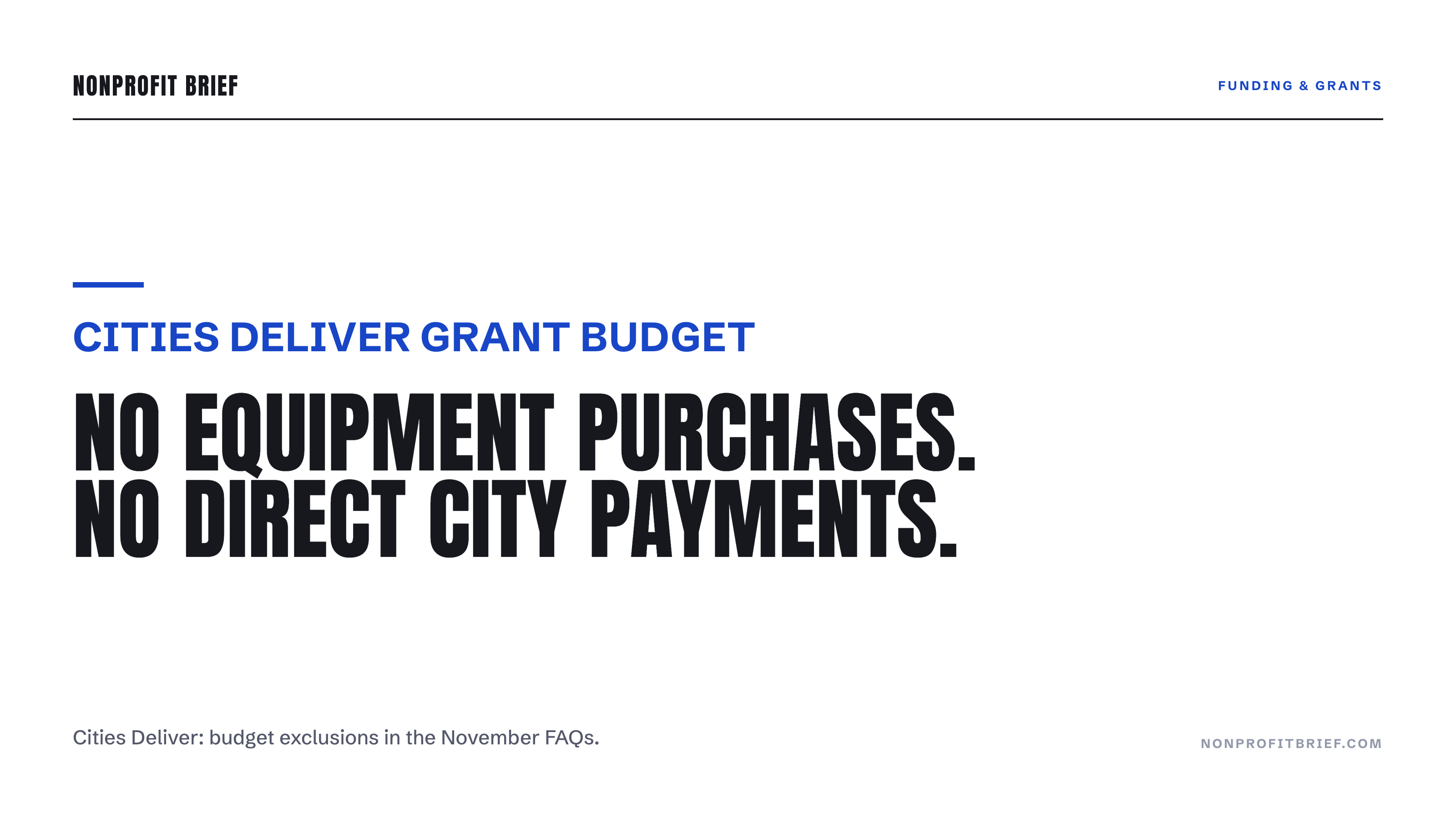
The November FAQs bar buying physical equipment with grant funds, whether for the grantee or a government entity. They also bar transferring funds directly to city partners through subawards, contracts, reimbursements, or other arrangements. Matching funds are not required.
The November FAQs describe an indirect-cost cap of 15% of direct costs, excluding consultant fees and sub-grants. The original terms instead describe 15% of the total grant. Because the program page gives the terms precedence, do not assume the newer calculation supersedes them; confirm the applicable basis with RFCC before finalizing your budget. For-profits cannot recover indirect costs, and company profit, markup, and management fees are barred. Substantive project-management staff time can be direct only at actual salary and fringe, specific to the project, documented and justified.
Submit a Complete Round 1 Package
The portal and screening and proposal questions set out the package: eligibility screening, proposal, city letter, legal-status documentation, and a video of five minutes or less with a visible presenter. Application materials, including demonstrations, must not contain residents' personal information or sensitive personal data; use aggregate, de-identified or synthetic examples.
The November FAQs allow legal documents and city letters in their original language with English translations in a combined PDF, and video narration in another language with English subtitles. Other materials must be in English. The November FAQs count the two-proposal cap as lead or partner participation, with special rules for university units and fiscal sponsors. The original terms count lead applications. These texts differ; flag overlapping partnerships and seek clarification rather than assuming either permits your combination.
The takeaway
Before committing staff time, confirm the applicant, city letter, project fit, and budget against all current documents. The Oct. 31 questions deadline has passed; the November update is available. Verify the portal again before submitting, and use the grant fit test to decide whether this opportunity merits a proposal.