Imagine a gala that raised $90,000. The board applauds, the venue asks about next year, and the development director has not counted the hours yet. Before anyone signs another contract, put the event through a second calculation: what did it leave after the resources it consumed?
A good gala can earn its place in your fundraising plan. The decision needs reconciled receipts and costs, a staff-time estimate, and a clear account of what happened to donor relationships. A full ballroom supplies none of those answers by itself.
Start With Two Views of the Same Event
First, reconcile event cash received, net of refunds. Include ticket payments, cash sponsorships, and event gifts. Keep unpaid pledges separate. List nonpayroll event costs, distinguishing amounts paid from invoices still due. Subtract both paid and unpaid event costs from collected receipts to show what remains after those obligations; show actual cash paid separately.
Next, add the cost of staff time assigned to the event. BoardSource's measurement framework includes staffing alongside other fundraising expenses. Feeding America's event guide makes the same point: count colleagues outside development who help make the event happen.
Ask each person for hours spent planning, recruiting sponsors, preparing materials, running the event, and following up. Multiply hours by an allocated hourly employment cost that includes salary and employer-paid benefits and taxes. Label estimates honestly. Count each expense once; do not add payroll again if it is already in your event total.
List donated goods, services, and facilities separately. Flag replacement costs if those gifts will not recur, and note any shared overhead excluded from the calculation. Identify donor restrictions before describing the remaining funds as available for general operations.
These are management views for deciding how to use resources, not instructions for classifying transactions on financial statements or tax returns. Have your finance lead reconcile them with the organization's records.
The Same Gala Can Produce Three Different Numbers
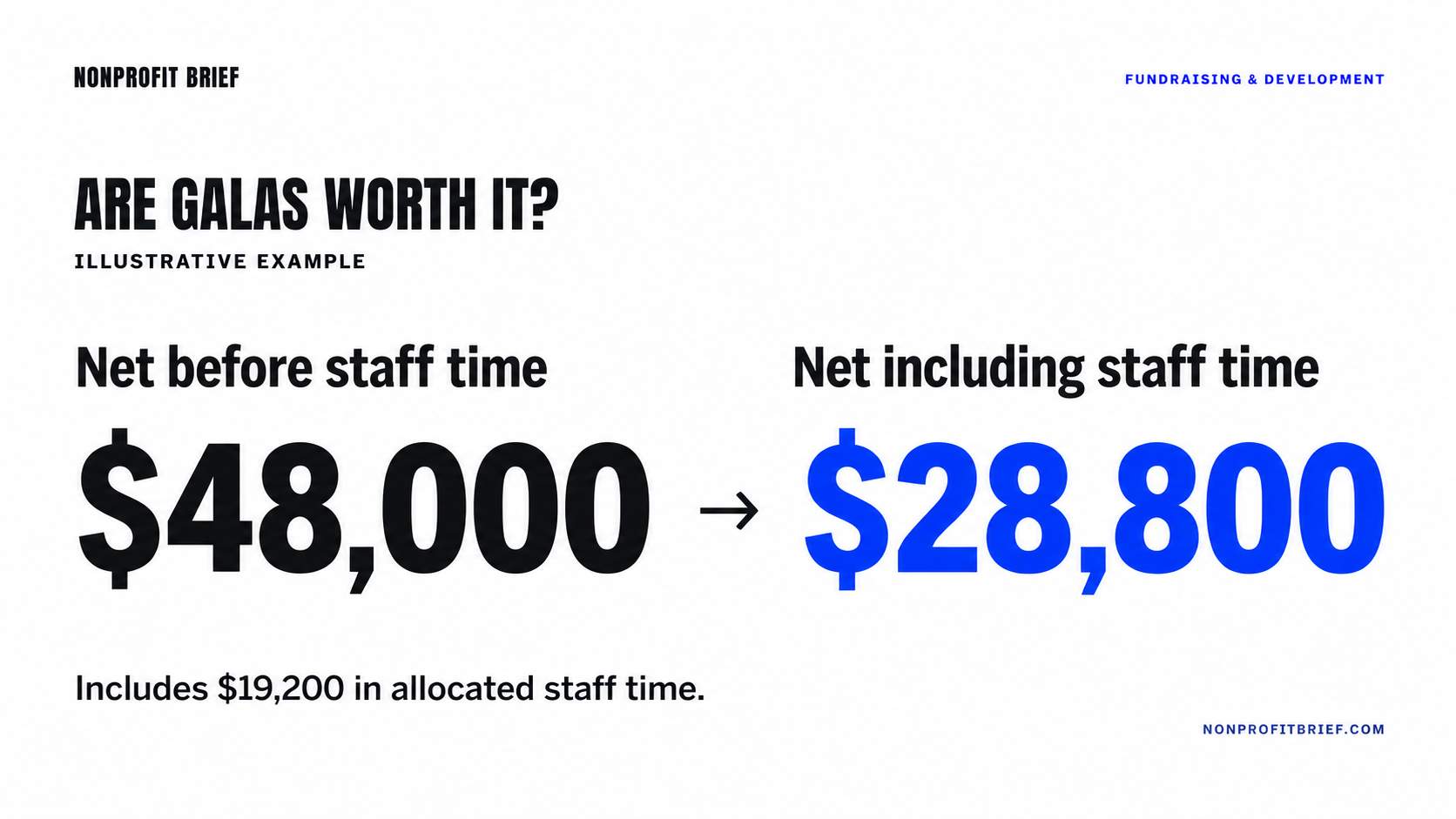
Here is a hypothetical event, not a sector benchmark. It collects $90,000 and has $42,000 of nonpayroll event expenses. Staff contribute 480 hours at an assumed average employment cost of $40 per hour.
- Collected receipts less nonpayroll event costs: $90,000 minus $42,000 equals $48,000.
- Allocated staff cost: 480 hours multiplied by $40 equals $19,200.
- Net after those costs: $48,000 minus $19,200 equals $28,800.
The event used $61,200 in the counted resources to bring in $90,000, or 68 cents per dollar received. It also produced $60 of net revenue per staff hour. Both calculations describe this example only. Neither number tells you, on its own, whether to keep the gala.
Already-budgeted salaries do not disappear if you cancel. The staff calculation measures resources used, not necessarily cash you could save. It gives the board a way to compare activities without pretending salaried time is free.
Test the Downside Before the Deposit
For the same hypothetical gala, suppose receipts fall 20% to $72,000 while the counted costs stay at $61,200. The remaining net is $10,800. The revenue decline is 20%; the net decline is 62.5%. That difference is why a modest miss deserves a serious discussion before commitments are made.
Build your own downside case from signed commitments and realistic attendance. Separate costs you can reduce from costs you owe regardless. Put payment dates beside them. A profitable forecast does not tell you whether enough money arrives before the venue needs its deposit.
The University of Kansas Community Tool Box guidance recommends setting revenue targets, expense limits, and a break-even point before carrying out a fundraiser. For your board discussion, add a minimum acceptable net and name the person who will decide whether to scale back.
Give Donor Relationships Their Own Scorecard
Some events deserve support because they deepen relationships. Give that purpose evidence of its own rather than quietly adding hoped-for future gifts to tonight's result.
Choose a follow-up window before the event. For example, review at 90 days: how many first-time supporters accepted a meeting, made another gift, or became recurring donors? Track the event cohort separately from existing major donors. Record the subsequent revenue and the work needed to secure it. Later giving alone does not prove the event caused it.
Feeding America's 2023 guide evaluates audience, finances, and strategic fit together. BoardSource likewise warns against judging fundraising effectiveness by cost alone. Use your donor retention review to see what continued after the evening ended. Attendance is an activity measure; a second gift is a different result.
Compare a Real Alternative
Do not compare an actual gala with an imaginary appeal that costs nothing and raises everything. Sketch a credible alternative using your own past results: a smaller sponsor reception, personal donor meetings, or the next year-end appeal campaign. Include its staff hours, cash costs, expected receipts, and uncertainty.
Keep volunteer effort visible in a separate capacity note. Record the hours and roles needed, whether people will return, and what happens if a key organizer leaves. Do not present donated time as cash available to pay bills.
Then choose: keep the format, redesign it around a clear objective, or retire it. If you keep it, document what must improve next year and when the board will review the result.
The takeaway
Before rebooking, bring the board reconciled receipts and paid and unpaid event costs, a staff-inclusive net, a downside case, and a donor follow-up plan. Compare those with one feasible alternative. The gala earns another year when the resources it uses serve a goal you can explain and measure.